🌱
Spring
Mar – May
Visit index
★★★★★
Prime window
Dust haze and pollen; by May the midday sun is already strong on the glass.
A circular reinforced-glass observatory at the highest point of the Gyeongin Ara Waterway (경인아라뱃길) in Gyeyang-gu, Incheon. About 46 m in diameter, with glass floor and railings of triple-layer tempered glass looking straight down at the 18 km canal and the Gyeyangsan gorge. Next to the 150 m-wide Ara Falls (아라폭포), glowing with night lights. Free admission and free parking.
Golden Hour Calculator · Light tool
Based on today's sunset, arriving about 60 minutes earlier lets you catch the softest diffuse light and the blue-hour sky — perfect for shooting the canal reflection on the glass floor and the Gyeyangsan silhouette.
The observatory is open gorge and water; afternoon to dusk gives the warmest light. On weekends or during night-lighting hours, allow extra buffer for crowds.
🌊 Night Lights tip: the railings, glass floor and neighbouring Ara Falls are all lit at night — the golden combo for 'glass + lights + water'. For handheld night shots, raise ISO or use a stabilizer.
Golden-hour reference
Suggested arrival
—
Blue hour
—
Welcome to AraMaru Skywalk, widely recognized as the central AraMaru. Located in the heart of Gyeyang-gu, Incheon, South Korea, at the highest point of the Gyeongin Ara Waterway (경인아라뱃길), this destination serves as a primary hub for travelers visiting the region — and it is the same landmark that the domain aramaruskywalk.com refers to.
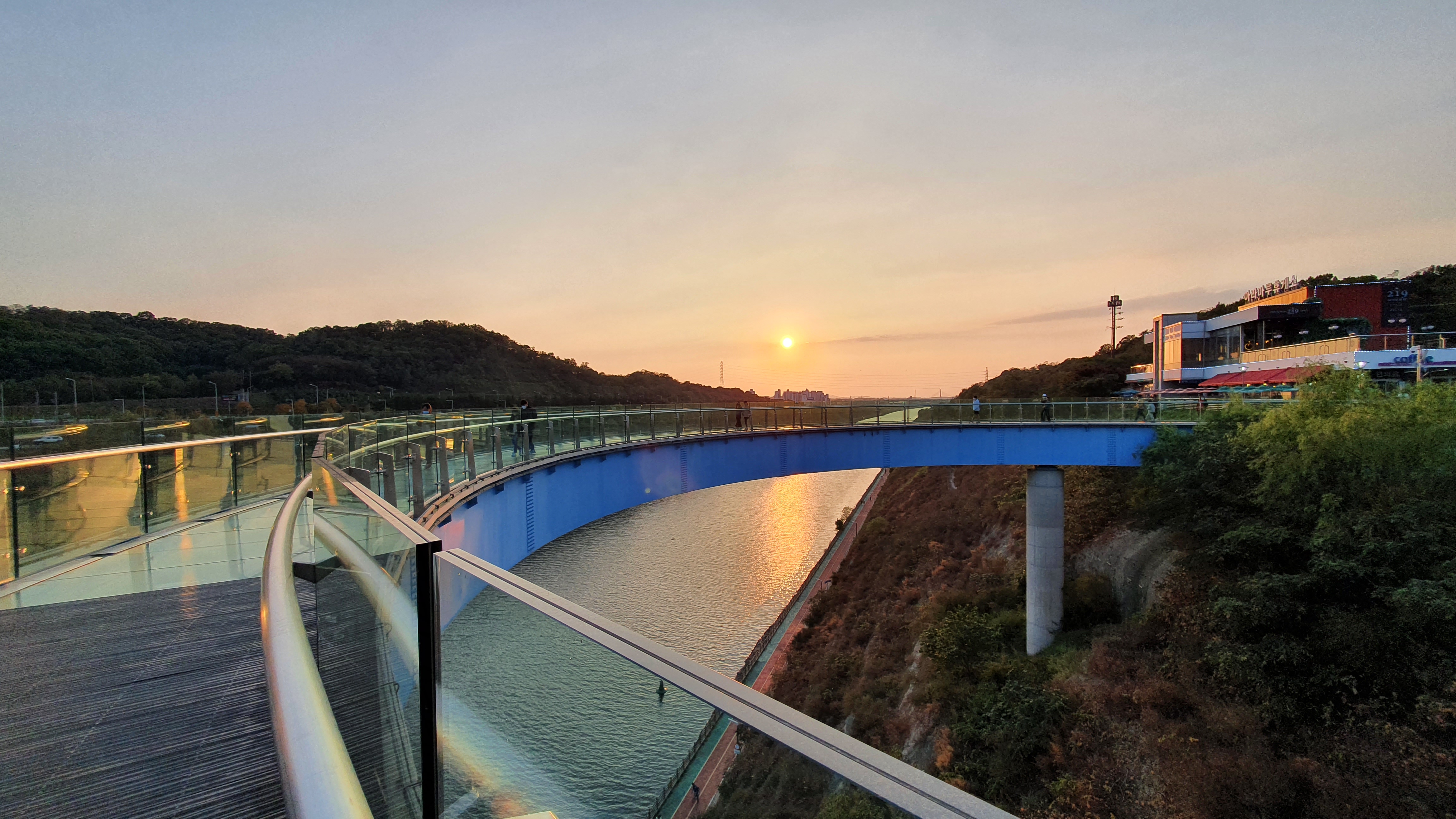
Geographic hierarchy
AraMaru Skywalk stands on the Gyeongin Ara Waterway green belt near Duksil-dong, Gyeyang-gu, Incheon, right beside the 150 m-wide Ara Falls. By car, set your navigation to "AraMaru Skywalk"; by public transport, take Incheon Metro Line 1 to Gyeyang Station and transfer to a bus or taxi for about 10–15 minutes.
Address
San 77-9, Duksil-dong, Gyeyang-gu, Gyeyang-gu, Incheon 21012, South Korea
Plus Code: 8Q98HPF2+4F
📍 Google Maps ↗For official updates and regional tourism information, visit South Korea / Incheon Official Tourism Portal .
When visiting AraMaru Skywalk, visitors can easily explore surrounding historical landmarks and points of interest, including Ara Falls (아라폭포) and Gyeyangsan (계양산).
A 150 m-wide canyon waterfall — water curtain by day, lit up at night, framing the glass observatory.
The city mountain enclosing the waterway; a high point for panoramic sunset views of the canal and the skywalk.
An 18 km waterside promenade linking the observatory, the falls and the green belt on level ground.
Incheon's best-known urban park — an easy half-day or full-day pairing with the skywalk.
AraMaru sits where the refrain of the Korean folk song "Arirang" (Ara-ri-o) meets Korea's water-engineering memory: the Gyeongin Ara Waterway opened in 2011, reconnecting the Han River with the West Sea across roughly 18 km. AraMaru occupies the highest point of that waterway in the Gyeyangsan gorge, and in 2015 its glass floor and railings were fully replaced — making it one of Korea's most recognizable glass skywalks.
Read the full history & origins →A few numbers to understand this glass observatory built over a canal.
Structure / Structure
Circular glass
A circular observatory about 46 m across, with glass floor and railings — you see the Gyeongin Ara Waterway right beneath your feet; one of Korea's most recognizable glass skywalks.
Glass / Glass
Triple tempered
The floor uses a triple-layer tempered-glass construction; in 2015 the railing glass and floor material were fully replaced, balancing transparency with safe load-bearing.
Location / Location
Highest point
Sits at the highest section of the Gyeongin Ara Waterway (경인아라뱃길) — the Gyeyangsan gorge — with excellent elevation and views over the gorge and waterway.
Night lights / Lights
Night lighting
Railings, glass floor and Ara Falls are all scenically lit after dark, making it a popular night-out and photo spot in suburban Incheon.
Coordinates / Coords
HPF2+4F Gyeyang-gu, Incheon, South Korea
Plus Code: 8Q98HPF2+4F, Gyeyang-gu, Incheon. Address: San 77-9, Duksil-dong, Gyeyang-gu, Incheon — next to the Gyeongin Ara Waterway.
Admission / Admission
Free
The observatory and on-site parking are both free, managed by K-water as part of the Gyeongin Ara Waterway — easy to drop by anytime.
Live
The glass deck sits in the Gyeongin Ara Waterway gorge, where wind, rain and chill read stronger than in the city centre. Check temperature, rain chance and gusts together before you set out.
Reading the latest observation…
—
Reading the latest observation…
Daily high and low, rain chance and daylight window at the platform.
The tempered-glass floor turns slippery after rain, snow or morning dew. Grip matters more than the view.
Long-term averages for the Incheon area. Use this table to choose a month, then use the live panel above to choose a day.
| Month | Mean temp | Precipitation | Visit index | What it means on site |
|---|---|---|---|---|
| Jan | −1.2 °C | 20 mm | ★★☆☆☆ | Coldest month. Wind chill on the open deck is the main discomfort. |
| Feb | 0.5 °C | 24 mm | ★★☆☆☆ | Still cold, but clear days give the sharpest glass reflections. |
| Mar | 5.9 °C | 39 mm | ★★★★☆ | Riverside green returns; occasional dust haze softens the long view. |
| Apr | 12.0 °C | 70 mm | ★★★★★ | Best balance of light, temperature and air clarity. |
| May | 17.5 °C | 96 mm | ★★★★★ | Long bright evenings; the gorge is at its greenest. |
| Jun | 21.9 °C | 117 mm | ★★★☆☆ | Rainy season opens; check the radar before you walk. |
| Jul | 24.9 °C | 307 mm | ★★☆☆☆ | Highest rainfall. The canal runs high and often turbid. |
| Aug | 25.7 °C | 272 mm | ★★☆☆☆ | Hottest and most humid. Go early morning or after sunset. |
| Sep | 21.5 °C | 144 mm | ★★★★☆ | Heat breaks and deep blue skies return. |
| Oct | 15.2 °C | 54 mm | ★★★★★ | Driest and clearest month — the classic photography season. |
| Nov | 8.3 °C | 46 mm | ★★★★☆ | Reeds and maples colour the banks; afternoon gusts pick up. |
| Dec | 1.4 °C | 23 mm | ★★★☆☆ | Night lighting is at its best; ice becomes the main hazard. |
Weather, water condition and wildlife read together. The same deck feels like four different places across the year — and each season asks something different of the visitor.
Mar – May
Visit index
★★★★★
Prime window
Dust haze and pollen; by May the midday sun is already strong on the glass.
Jun – Aug
Visit index
★★☆☆☆
Early or late only
Heat, lightning and slippery glass. Leave the open deck at the first thunder.
Sep – Nov
Visit index
★★★★★
First choice
Large day–night temperature swing — carry a windproof layer for the evening.
Dec – Feb
Visit index
★★★☆☆
Clear midday hours
Ice on the deck and ramps, and fog that can erase the view entirely.
| Season | Weather & air | Water condition | Wildlife & vegetation | Visit index | What to watch |
|---|---|---|---|---|---|
| 🌱 Spring Mar – May | 5 → 20 °C. Dry, bright and windy; dust episodes can soften the far view. Day–night swing is the widest of the year. | Snowmelt turbidity settles by late March. Algal activity is low, so the canal reads clear and blue-green. | Migratory birds push north, riverside trees leaf out, early blossoms open on the lower slope. | ★★★★★ Prime window | Dust haze and pollen; by May the midday sun is already strong on the glass. |
| ☀️ Summer Jun – Aug | 22 → 31 °C. Rainy season from late June to mid-July, then sudden convective downpours and tropical nights. | Rain drives turbidity up quickly and the flow rises. Stagnant reaches can develop surface algae in August. | Peak insect and bird activity; waterside vegetation is dense and hides the banks. | ★★☆☆☆ Early or late only | Heat, lightning and slippery glass. Leave the open deck at the first thunder. |
| 🍁 Autumn Sep – Nov | 22 → 8 °C. Stable high pressure, low humidity and the longest clear spells of the year. | The most stable and transparent water of the year, with little flow variation. | Migratory flocks pass through; reeds and maples colour both banks. | ★★★★★ First choice | Large day–night temperature swing — carry a windproof layer for the evening. |
| ❄️ Winter Dec – Feb | −5 → 3 °C. Cold snaps, snow events and occasional sea fog drifting inland from the west. | Still sections can freeze at the surface; the canal carries its lowest flow of the year. | Wintering waterfowl gather; bare branches open long sightlines across the gorge. | ★★★☆☆ Clear midday hours | Ice on the deck and ramps, and fog that can erase the view entirely. |
Each row combines three variables that change in step with one another: air and rain, the canal's water condition, and what the riverside ecosystem is doing. Long-term monthly averages are used as the baseline, so any single year can sit well outside the pattern.
Not what you might like, but how you should actually walk it: where to start, how long it takes, and what to skip.
Parents with toddlers, strollers or grandparents in the group.
Route
Practical tips
Watch out · Never let children lie down or sit on the glass for photos; the deck is a walkway, not a playground.
Travellers chasing light, reflections and the gorge landscape.
Route
Practical tips
Watch out · Do not climb, lean over the railing or enter closed sections to improve a composition.
Wheelchair users, visitors using canes, and anyone who prefers the shortest possible walk.
Route
Practical tips
Watch out · If ice or heavy rain is present, consider viewing from the lawn area instead of the glass surface.
Two ready-to-walk plans. One fits around a morning or an evening; the other fills a whole day and connects the deck with the wider waterway.
Ⅰ
3 – 4 hours · 2.5 km on foot · best in the morning or before sunset
Ⅱ
6 – 8 hours · 6 – 9 km · combines the deck, the waterway and central Incheon
Timings assume a relaxed pace and normal traffic. Add buffer time on weekends and public holidays, and check the live weather panel before committing to the evening leg.
AraMaru Skywalk (Korean: 아라마루 전망대) sits in Duksil-dong, Gyeyang-gu, Incheon, next to the highest section of the Gyeongin Ara Waterway (경인아라뱃길) — the Gyeyangsan gorge. It is a circular reinforced-glass observatory about 46 m in diameter, with glass floor and railings letting you look straight down at the 18 km canal and gorge landforms. Next to it is the ~150 m-wide Ara Falls (아라폭포), dazzling after dark. 'Ara' comes from the refrain '아라리오' of the Korean folk song Arirang, echoing this canal linking the Hangang River and the West Sea.
Highlights
Circular reinforced-glass observatory ~46 m across, glass floor & railings — 'see the water through your feet'
Fully renovated in 2015 with a triple-layer tempered-glass floor — transparent yet safe
At the highest point of the Gyeongin Ara Waterway, overlooking the 18 km canal and Gyeyangsan gorge
Next to the ~150 m Ara Falls — water by day, lights by night, mutual scenery
Free admission & parking, managed by K-water, visit anytime
AraMaru Skywalk is in Duksil-dong, Gyeyang-gu, Incheon — a glass observatory grown from a Gyeongin Ara Waterway facility, maintained by K-water as public space. It has long been a greenbelt living-room shared by citizens strolling, travellers checking in and families, and is one of Incheon's 'canal and gorge' city cards.
A century-old engineering ambition, a folk song, and a hillside that has been a transport corridor since pre-modern times — the deck makes more sense once you know what lies under it.
The first element of the name is generally linked to the refrain of Arirang, the best-known Korean folk song, whose syllables echo through the waterway's branding. It also carries the plain sense of the sea and of a wide open reach.
In Korean, maru refers both to a raised wooden floor and to a ridge or high point. Applied to a circular platform hanging over a gorge, the word works in both senses at once.
Among local walkers a gentler story circulates: that the great canal project was dreamed of for generations and abandoned again and again, and that the deck was built on the highest point of the valley so that the imagined boats could at last be watched arriving. It is told as a story about patience rather than as recorded history.
A second telling says the glass floor was deliberately made transparent so that the canal would never be hidden from the people who paid for it with decades of disruption. Residents' groups repeat it as a reminder that infrastructure and civic space can share the same structure.
The Gyeyang area sits on the historic route between the Han River settlements and the port of Incheon, which is why fortifications, roads and later railways and canals all gathered here.
Interest in a Han River – Yellow Sea canal was revived during the colonial period for shipping and irrigation surveys, and the idea resurfaced repeatedly in post-war development plans before finally being built as a smaller recreational and navigation waterway.
The circular form, the wide glass railing and the adjacent falls are all responses to the same constraint: a narrow gorge with a working canal below, where the visitor must be lifted above the water without interrupting navigation.
This section separates recorded history from storytelling on purpose. Items marked as local storytelling are presented as community narrative and are not documented historical claims.
Put the Gyeongin Ara Waterway's past, the glass structure's origin, Ara Falls and night lights on one timeline to truly understand why this observatory is more than 'pretty glass'.
The Gyeongin Ara Waterway (경인아라뱃길) is an ~18 km artificial canal from the Hangang River north to the West Sea (Yellow Sea) south, restoring the water link between Seoul and Incheon. AraMaru sits at its highest point — the Gyeyangsan gorge — the best vantage over canal and gorge.
'Ara' comes from the refrain '아라리오 (Ara-ri-o)' of the Korean folk song Arirang, echoing this canal waterway; '뱃길' means boat road. The name carries both folk-song memory and Incheon's waterward cultural image.
The observatory is a circular reinforced-glass structure about 46 m across, floor and railings all glass, letting visitors look straight down at the canal. This transparency turns 'watching water' into a bodily experience — one of Korea's most recognizable glass skywalks.
In 2015 the facility was fully renewed: railing glass and triple-layer tempered floor material replaced, enhancing transparency while strengthening safe load-bearing. Today's AraMaru is the stably operated public observatory after that renewal.
The neighbouring Ara Falls (아라폭포), about 150 m wide, uses the Gyeyangsan gorge to create a vertical waterscape — the core of the waterway's 'tourist leisure' section. Water by day, lights by night, mutual scenery with the glass observatory.
AraMaru's Gyeongin Ara Waterway is the 4th of the 'Eight Scenic Views of the Waterway', routinely managed by K-water. With accessible ramps, it is part of the Korea Tourism Organization's Barrier-Free system — wheelchairs and strollers reach it on a gentle path.
Railings, glass floor and Ara Falls are scenically lit after dark, extending AraMaru from 'see water by day' to 'see lights by night' — a popular night-out and photo spot in suburban Incheon, continuing the waterway's role as a public living-room.
AraMaru is more than a glass observatory — it is an open-air classroom of Korean water heritage and folk memory: from 'Ara' in Arirang, to the highest point of an 18 km canal, to triple tempered glass and the 150 m Ara Falls — land and water written into one Gyeyangsan gorge.
What's worth reading slowly on-site isn't the check-in board, but the official plates and maps explaining 'why this glass is here'.
The readings below are based on AraMaru introductions, glass-structure notes and waterway guides set by Incheon Metropolitan City and K-water, turning visible-but-unread info into understandable English science.
아라마루 연혁
AraMaru history
📍 On-site location · Observatory main entrance
Such plates usually give the key background: the Gyeongin Ara Waterway linking Hangang and West Sea, and AraMaru as the highest-point glass observatory. Reading it is lesson one in using this water-heritage landmark.
유리 구조 안내
Glass structure guide
📍 On-site location · Glass platform entrance
Plates stress AraMaru's status as a glass skywalk and remind visitors: half its charm is the transparent view, half the real canal beneath. They explain clearly 'why glass'.
아라폭포 안내
Ara Falls guide
📍 On-site location · Falls viewing area
The map explains 'why this is the leisure core': Ara Falls uses the Gyeyangsan gorge for a vertical waterscape. With the glass observatory, AraMaru's design logic is clear — water facilities and public recreation coexist.
아라뱃길 안내
Ara Waterway guide
📍 On-site location · Path toward the waterway
Set by K-water, marking AraMaru's link to the Gyeongin Ara Waterway. It reminds every visitor: this glass sits on Incheon's most water-valuable canal greenbelt and most transparent viewing experience.
Look past the surface 'pretty' to find what's rare here: a public water facility, a canal memory and an open-air urban viewing classroom all at once.
Glass observatory over a canal
AraMaru's hardest core is both visible and invisible. Visible: circular glass and the canal below; invisible: the water ambition of 'linking Hangang and West Sea' and Incheon's urban-renewal memory. Visitors see landscape; water buffs see a running waterway system.
AraMaru's cultural symbol
Circular glass, Ara Falls and the Gyeyangsan gorge, like the Gyeongin Ara Waterway, form AraMaru's identity system: instantly saying 'Incheon, canal, and a gentle transparent water aesthetic'. From see-through feet to night lights, this contrast makes it one of Incheon's most memorable city images.
What's most worth learning about AraMaru isn't 'it got prettier' but how it folded a Gyeongin Ara Waterway facility back into public water memory while keeping reverence for nature.
AraMaru isn't a 'hide the canal and done' case, but a sample that keeps activating waterway facilities as shared space through public design.
Plates, glass structure and guides aren't just navigation but let visitors quietly join respect for public environment and others while using the space.
AraMaru didn't erase the waterway's past; through glass, Ara Falls and signage it lets the public sense what this land went through while visiting.
Not just 'you'll like it' — tells you how to go, where to start, and which Incheon nodes to link.
Resonance: Free, open, safe flat glass platform; kids peek at the canal below, view the gorge, and easily reach Ara Falls on the gentle side.
Tip: Spend energy on photo stops, not on crowding.
Resonance: Morning/dusk glass reflections are Incheon's most romantic frames, high hit rate.
Tip: Count arrival, return and light into the plan so composition isn't beaten by the scene's pace.
Resonance: As a water-facility sample, the waterway prehistory, glass structure and Ara Falls deserve close looks.
Tip: Avoid the most crowded weekends; choose morning or weekday afternoon to really observe details.
Resonance: Without going far, observe Korean water culture, folk memory and gorge landforms in suburban Incheon; link subway, bus and local food — an ideal start for the 'canal and gorge' theme.
Tip: If only one Incheon suburb landmark fits, AraMaru is the best first stop for 'water and city'.
Combining arrival into Incheon, in-city transfers, walking/cycling, parking & charging for a clearer AraMaru plan.
AraMaru Skywalk is in Duksil-dong, Gyeyang-gu, Incheon, next to the highest Gyeyangsan-gorge section of the Gyeongin Ara Waterway (경인아라뱃길) — Incheon's most recognizable suburban glass observatory. The easiest external transport is subway from Seoul or driving via the Gyeongin area; once in Gyeyang, transfer from Gyeyang Station (Incheon Line 1) by bus or taxi about 10–15 min. The observatory is in the waterway greenbelt, a short walk from the drop-off.
AraMaru is an open greenbelt with a free parking lot. Plan transport, parking and walking together — especially with seniors, kids or luggage, parking free then walking saves hassle.
Subway (Incheon Line 1 · Gyeyang Stn)
Easiest for most — transfer to Incheon Line 1 to Gyeyang Station from Seoul or central Incheon, the classic way to AraMaru.
AraMaru has a free public parking lot; below are the nearest main options. Rates and spaces vary by season/time — follow on-site signs.
| Option | Distance | Price |
|---|---|---|
| AraMaru on-site free lot | ~50–200 m to observatory | Free public, fills in peak |
| Gyeongin Ara Waterway roadside lot | ~200–500 m | Public/free, more spaces but tight in peak |
| Nearby street temporary | ~200–500 m | Roadside/small, fewer spots, easier on weekdays |
| Gyeyang Station park-and-ride | ~1.5–3 km | Park-and-ride discount, needs transfer |
| Drop-off (near observatory) | ~50–100 m | Drop only, no spaces |
Roads near the observatory clog on holidays and night-lighting hours — don't block bus/fire lanes. EV chargers are mostly in public lots; rates/limits may change — check posted signs.
AraMaru is open 09:00–22:00 daily, but the photo ceiling is the morning/dusk light window. Arrive about 60 min before sunset; if weather hurts photos, shift focus to Ara Falls lights or a waterside-path stroll.
A free public lot is on-site, walkable. Fills easily on weekends/holidays — arrive early or prefer transit.
The AraMaru on-site free lot is ~50–200 m away; the Ara Waterway roadside lot is ~200–500 m, more spaces but tight in peak.
Little. Roads are narrow and clog on holidays — don't park long on the street; use proper lots and transit.
Unless you need parking, don't. Weekends and night-lighting hours are congested; walking or transit is smoother. If driving, park free then walk in.
Strongly. Incheon Line 1 to Gyeyang Station, then bus/taxi about 10–15 min to the observatory — easiest. Address: San 77-9, Duksil-dong, Gyeyang-gu, Incheon, South Korea.
For stability, transit wins: subway to Gyeyang, transfer. If driving, treat free parking and transfer as part of the plan, not 'park at the door'.
What is actually available on and around the site, described by category rather than by business. This is a non-commercial reference: no specific shop, restaurant or hotel is recommended.
Public park restrooms near the car park and rest areas
The deck itself has no toilet. Facilities closest to the platform can queue at weekends; the accessible cubicle is normally in the main rest area.
Free on-site public car park
No ticket or reservation is needed. Weekend afternoons fill first; when the main car park is full, look for a signed alternative lot and walk in.
Korean restaurants, snack bars, bakeries and cafés in the surrounding district
There is no restaurant on the deck. Convenience stores cover drinks and simple meals; a packed picnic on the lawn is common and welcome.
Business hotels and motels in the Gyeyang district; larger hotels toward central Incheon and Songdo
Nothing is on the site itself. Staying in the Gyeyang area shortens the morning trip; staying downtown trades that for restaurants and transit links.
Convenience stores, supermarkets and pharmacies in the surrounding district
Buy water and snacks before arriving. Pharmacies keep normal commercial hours and may be closed on public holidays.
Petrol, diesel and LPG stations nearby; EV chargers at public car parks and commercial lots
Charging bays at the busiest times are occupied, so check the operator's own app for live availability before depending on one.
Ramps and accessible restrooms in the public areas
The main ramp reaches the deck without steps. Handrails are fitted, but the surface can be wet — take the slope slowly.
Emergency services (119 / 112) and hospitals or clinics in the district
Note the location of the nearest defibrillator and the emergency call point on arrival. The gorge path has no lighting along every metre.
Limited public bins in the park area
Bins are sparse by design and are often full after busy weekends. Carry a small bag and take your waste away with you.
Normal mobile coverage, with weak spots in the gorge
Signal can drop on the lower waterside path. Save the map offline if you are navigating by phone.
Listing a category does not mean endorsing any particular operator. Prices, opening hours and availability change — confirm locally before you rely on them.
Not just 'who it suits' — a walkable half-day line. Centred on the glass observatory, it links Ara Falls, the waterway path and nearby rest spots.
[Start] Glass observatory & see-through view
Core experience · ~40 min
Begin on the circular glass platform of AraMaru Skywalk, looking down at the Gyeongin Ara Waterway and Gyeyangsan gorge, tracing the canal and distant ridges — save the soft morning or dusk light for this transparent landscape.
[Star] Ara Falls & night lights
Water experience · ~30 min
Walk along the waterway to the neighbouring Ara Falls (아라폭포) — a ~150 m artificial waterfall using the Gyeyangsan gorge; water by day, lights by night, AraMaru's most photogenic partner.
[Extend] Waterway waterside path
Local life · ~60 min
Stroll the Gyeongin Ara Waterway waterside path (수변 산책길), feeling the glass skywalk and canal greenbelt together — Incheon's most comfortable flat, waterside route.
[Refuel] Rest area & light meal
Culture break · ~40 min
Refuel at rest areas and snack spots near the waterway, then look back at the canal and hills, collecting nature and urban water heritage.
[End] Return or extend to Gyeyang
Wrap · ~60 min+
If energy allows, explore Gyeyangsan or Gyeyang-area shops; otherwise bus or drive back, wrapping the route into a complete 'glass + falls + waterway' half-day pack.
The route emphasizes a 'works even if you just follow it' loop; if you only want the glass observatory, keep the first two stops and treat the path and rest as optional add-ons.
AraMaru is a glass skywalk over a canal, set in the Gyeyangsan gorge by the water and cliff. Think through safety, timing and budget, and the experience upgrades from 'rush to check in' to 'relaxed visit'.
Footwear safety
Wear non-slip flats
Glass floors get slippery when wet — wear non-slip shoes, avoid heels; be extra careful in rain or with morning dew, and watch children and seniors.
By the water & cliff
Don't climb railings
The circular glass structure is by water and cliff — don't lean on or climb over railings, keep a safe distance from the edge when taking photos, and follow on-site guidance.
Weather & routine
Bring wind & water
The gorge is windy and can be hot in summer, cold in winter — bring a windbreaker and water; protect from sun or cold at midday or low temperatures.
The observatory is free and open 09:00–22:00, with free on-site parking — no ticket or reservation needed, visit anytime (please keep quiet at night and respect neighbours).
The floor is triple tempered glass with railings — structurally safe; but by water and cliff, and slippery when wet, so hold children's hands, support seniors, and avoid wet times. An accessible ramp lets wheelchairs and strollers reach the platform on a gentle path.
Light rain is fine, but glass gets slippery and the gorge is windy — wear non-slip shoes and hold the railings. In strong wind, thunderstorms or maintenance, follow closure notices and come another day.
This is both a visitor glass observatory and a waterway greenbelt strolled by Incheon citizens. Following these rules is double respect for the natural gorge and for others.
The observatory is in a gorge greenbelt with limited bins — bring a small bag, take it away when you leave, especially cigarette butts, plastics and food scraps, keeping the glass deck and paths clean.
The glass skywalk is open and echoey — lower your voice, no loud music, leave room for those taking photos and pausing.
Some passages and parking areas are no-smoking — obey signs, don't smoke among wooden fixtures or crowds.
The glass floor and railings are public amenities — don't step on, scratch or act dangerously, so the 'see the water through your feet' experience stays safe and vivid.
Incheon is a port city 'where river, sea and city meet'. We don't recommend specific hotels but help you read two lodging patterns to choose.
Closest to observatory & greenbelt
Staying in Gyeyang or near the Gyeongin Ara Waterway, a short bus/car ride reaches AraMaru, Ara Falls and the waterway path; night lights and gorge wind suit travellers. Best for 'glass stroll + waterside' with high convenience.
Commute: to observatory by bus/taxi about 10–20 min. Walking is easy on legs — good for dawn platform strolls.
Best for food & coast
Staying in central Incheon or Songdo, near subway hubs, coast and food streets — best for 'sea + transfer' travellers, then subway or drive to AraMaru by day.
Commute: subway to Gyeyang Station about 20–50 min. Good for self-drive or independent travellers wanting absolute convenience.
Incheon's spring/autumn viewing seasons and weekend night-lighting hours tighten rooms and raise prices. Book weeks ahead; if booking near a holiday, expand to Seoul, Bucheon and nearby areas, then rail or drive.
This is a working waterway and a public garden, not an amusement park. A few habits keep the glass intact, the canal clean and the next visitor's experience as good as yours.
Bins are deliberately limited. Cigarette ends, plastic and food scraps are the most common litter on site — take them with you.
The floor and railing are a public asset. Do not scrape, jump on, or attach anything to the panels.
The circular deck amplifies sound. Keep music personal and give way to people taking photographs.
Parts of the walkway and car park are smoke-free. Open flame and portable stoves are unsuitable for the grassland.
Bread and snacks harm waterfowl and foul the water. Watch from a distance; do not approach nests or resting birds.
The waterway is managed infrastructure with airspace restrictions. Obtain permission before any drone flight.
This page is an independent, non-commercial educational reference. It exists to explain a public place accurately, not to sell anything.
San 77-9, Duksil-dong, Gyeyang-gu, Incheon, South Korea (Plus Code: 8Q98HPF2+4F)
For official updates and regional tourism information, visit South Korea / Incheon Official Tourism Portal .
Practical info on AraMaru Skywalk's facilities, history and visit planning.
A free public lot is on-site, walkable. Free parking, but fills easily on weekends/holidays — arrive early or prefer transit.
AraMaru has a gentle accessible ramp; wheelchairs and strollers reach the glass platform fairly easily. But by water/cliff and slippery when wet — stay on hard ground with company.
The observatory is an open glass platform; restrooms and snacks are in nearby rest areas and the waterway greenbelt. Refuel water/food at rest areas before entering.
Public lots have EV chargers; traditional fuel stations are along Gyeyang-area and Incheon city roads — self-drive visitors can refill en route.
'Ara' comes from the refrain '아라리오 (Ara-ri-o)' of the Korean folk song Arirang, echoing this canal linking Hangang and the West Sea; '뱃길' means boat road. The name carries folk memory and Incheon's waterward image.
AraMaru isn't a theme park but a public observatory grown from a Gyeongin Ara Waterway facility — weaving water heritage, folk symbols, glass art and gorge greenbelt. Circular glass, Ara Falls and the waterway path form a low-impact, high-empathy design, and one of Incheon's 'canal and gorge' city cards.
AraMaru is an open public observatory, free and open 09:00–22:00, no gate, no ticket or reservation — visit anytime (respect the environment, no late-night noise).
A relaxed visit is about 1–2 hr (glass platform + photo stops); with Ara Falls and the waterway path, allow a half-day.
Yes — the observatory is open in any weather. But in strong wind, heavy rain or thunderstorms, take care, wear non-slip shoes, watch the forecast; glass is slippery when wet.
From AraMaru you can link Ara Falls (아라폭포), the Gyeongin Ara Waterway waterside path (수변 산책길), Gyeyangsan (계양산) and Gyeyang-area shops into a 'glass–falls–waterway–gorge' half-day water-heritage route.
Ara Falls (아라폭포) is a free public waterscape a short walk along the waterway path from the glass deck. The water curtain runs year-round — water by day, and after dark it joins the observatory's night lighting. Since the deck is open until 22:00, evening is the best time to see both lit.
As Incheon's most recognizable glass observatory, a few structured spots and times greatly boost your photos' usefulness and beauty.
📍 Platform centre
Morning to dusk, the triple tempered glass spreads underfoot — AraMaru's classic 'glass–canal' composition; backlit glass silhouettes are striking.
📍 Water-side of platform
Shooting down from the water side folds 'glass + canal + Gyeyangsan' into one frame — AraMaru's most recognizable spot.
📍 Falls viewing area
Blue hour (20–30 min after sunset) balances sky and water best — the most atmospheric window, falls vivid against the cool sky.
📍 Platform toward falls
After dark, railings and glass floor light up; AraMaru reflects a river of lights — great for closing long-exposure night shots and glass portraits.
From the see-through view of the circular glass observatory and the Ara Falls curtain to the night lights of the Gyeyangsan gorge — the visual beauty of AraMaru Skywalk.
Image rights:All images displayed on this website remain the property and copyright of their original photographers. They are shown here for non-commercial information purposes only; please contact us for any copyright concern.
Visitor quotes
“Standing on triple glass with the canal right under my feet — that transparency is special, and at dusk the light makes it feel like floating on water.”
“Free and open glass observatory, a few steps from Ara Falls — the most underrated corner of suburban Incheon.”
“Walked the glass platform slowly with my kid, who kept peeking at the water below; easy for my parents too.”
Visitor feedback is available on Google Maps (external link).
Visited at dawn; the glass floor backlit is super photogenic, and the platform centre was silent — strongly recommend dusk for the best light.
The circular glass structure is stunning; about 15 min from Gyeyang Station. Incheon is windy by the sea — bring a jacket.
Great as free public space; weekends get crowded — weekdays or early morning are more comfortable.
About 15 min by bus from Gyeyang Station to the glass platform; the greenbelt along the way is pleasant for a half-day stroll.
All information on this site is cross-checked against the public materials of the government and public bodies listed below, to support the site's E-E-A-T credibility.
For official updates and regional tourism information, visit South Korea / Incheon Official Tourism Portal .
These are external authoritative sources; we are not responsible for updates or accuracy of third-party content.